2.3.1.
The latest stable version is
3.2.0.
sysand add hugoormo/mbse-recursive-architecture-wave-pattern 2.3.1
MBSE Recursive Architecture Wave Pattern
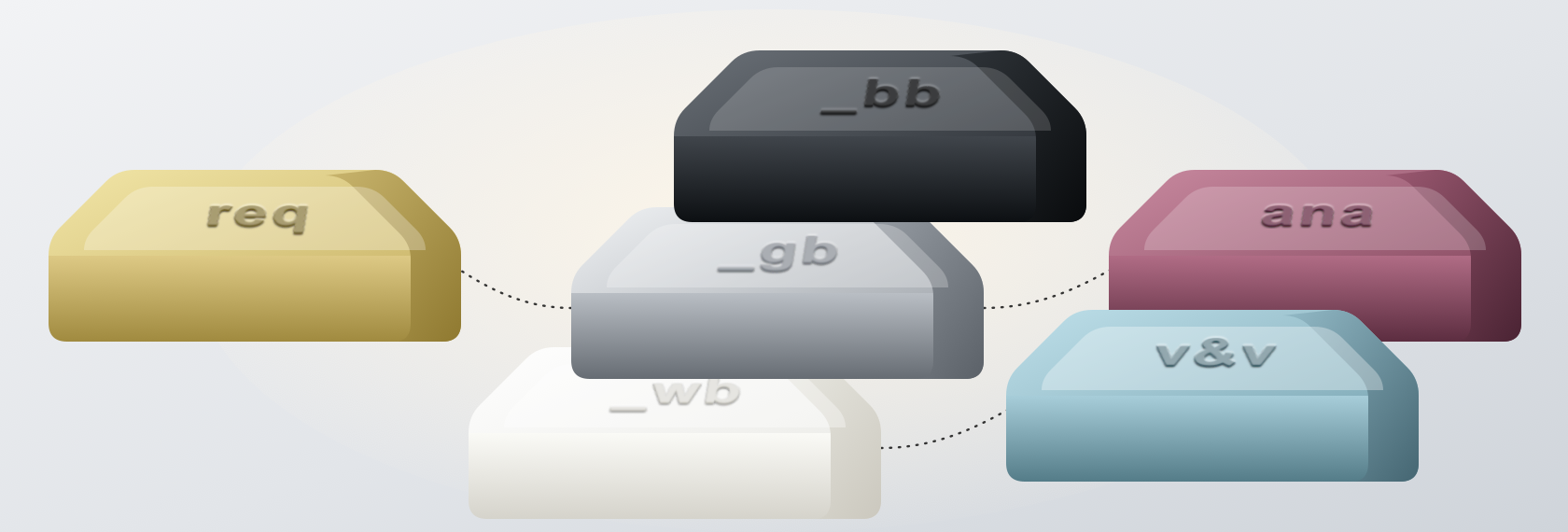
The MBSE Recursive Architecture Wave Pattern (RAWP) is an OOSEM-based SysML v2 reference model for requirements-driven behavioral modeling with recursive decomposition. It builds on the blackbox/graybox/whitebox decomposition pattern developed for the SysML v2 update of OOSEM, and carries requirements, analysis, and verification through that same recursion. It is machine-readable, structurally executable where current SysML v2 tooling supports execution, and intended for reuse as a practical MBSE project baseline.
Overview
The pattern combines:
- Recursive requirement decomposition across model levels.
- Structural allocation using explicit budget attributes.
- Behavioral realization via action execution and value propagation.
- Verification cases bound to integrated model contexts.
- Layered interface/stack-port modeling for interaction semantics.
Relationship to OOSEM
OOSEM foundation
OOSEM (Object-Oriented Systems Engineering Method) is being updated for SysML v2 by the OMG Systems Modeling Community and the INCOSE OOSEM Working Group. Part of that update is the recursive system decomposition pattern by Friedenthal and Muxen: a blackbox specification at each level is specialized into a graybox that decomposes it into the blackboxes of the next level, and into a whitebox that replaces those blackboxes with their grayboxes. This keeps specification and design separate at every level and lets design alternatives be explored without cloning the system hierarchy.
RAWP adopts this pattern as its backbone, applied with a usage-focused approach.
Each element is specified as a _bb blackbox; decomposed elements are refined
into _gb grayboxes and integrated in _wb whiteboxes, while leaves remain
blackboxes. Requirements are derived level by level along the same chain. RAWP therefore
positions itself as an OOSEM-based pattern. It does not restate OOSEM's
full set of activities; it shows, in an executable example, how the OOSEM
decomposition pattern can carry a complete MBSE thread.
RAWP additions
On top of the OOSEM decomposition pattern, RAWP adds further concepts that, after community validation, may also be included in future OOSEM releases:
- Framework closure by overlay at L0. RAWP closes the recursion the INCOSE HBv5 way, in plain RAWP terms: a business or mission level states the ConOps and hands operational needs to an operational initiative, and Level 0 states the OpsCon and hands needs to the systems. An enterprise architecture framework can close it instead, as a separate package that specializes the neutral Level 0 elements with its own types, so Levels 1 to 3 are the same under both closures. The companion package MBSE Recursive Architecture Wave Pattern - UAF Closure does so for UAF, with taxonomy elements that specialize both a UAF ontology and the RAWP operational ontology.
- Recursive closure of requirements. Child needs are handed down by the
integrator and accepted when a lower-level requirement subsets them.
Constraints are inherited through subsetting rather than restated, and each
derived requirement checks that its constituent budgets close against the
parent target (
recursiveClosureRule). - Analysis carried by the recursion. Allocation-selection analyses return
the selected allocation, and the requirement budgets of the next level bind to
that result, with execution provenance as metadata
(
MyFrameworkAnalysisMetaPatterns). Degradation and trade-study analyses support decisions but feed no requirement. - Verification carried by the recursion. Verification objectives verify a
local
satisfyusage on the integrated subject, and verification one level up counts as validation one level down (recursiveClosureRule,verificationSubjectAndObjectiveRule). Reference-mode verdicts stay inconclusive. The maturity of each part is rated in Verification Maturity. - Needs and Design use cases. Use cases form a behavior-identification
model orthogonal to the architecture. The integrator authors each
constituent's Needs use case, the constituent's Design use case specializes
it, and both link to the executable leaf behavior only by subsetting
(
useCaseIntentTraceabilityRule). - Concern-first requirements and life-cycle concepts. Stakeholder concerns
are framed by life-cycle concept objectives, viewpoints, needs, and analysis
objectives, from ConOps and OpsCon down to the leaves (
concernFramingRule,lifeCycleConceptRule). - Rich connectors and layered interfaces. Whitebox connections own their
interfaces, and interfaces can be layered as stack ports
(
richConnectorOwnershipRule,stackLayerSelectionRule). - Standards as constraint overlays. Parts that subset a standard's complying
part inherit its
satisfyrelation, so compliance is structural (standardComplianceOverlayRule). - COTS leaves. Supplier-owned products terminate a branch at the supplier
boundary rather than at a decomposition depth (
COTSConnectorBoundaryRule). - Concern-driven viewpoints and views, layered into selection, column, and
purpose views (
viewLayeringRule,concernDrivenViewRule). - Mapping to reference sources (INCOSE SE Handbook, INCOSE Needs and
Requirements Manual, SEBoK, ISO/IEC/IEEE 42010) in
MyFrameworkReferenceSourceMapping.
Credits
RAWP composes and extends the work of others. The model carries the full
attribution as metadata in Credits/Credits.sysml; this section summarizes it.
| Source | Authors | Used in RAWP for |
|---|---|---|
| A SysML V2 Modeling Pattern for Recursive System Decomposition, INCOSE IS 2026 | Sanford Friedenthal, Andrew B. Muxen | Recursive decomposition and requirement-derivation baseline (the OOSEM pattern) |
| The SysML v2 Book, chapter 33.1 | Tim Weilkiens, Vince Molnar | Use-case structure and flow modeling |
| Advent of SysML v2 – Lesson 13: Ports, Interfaces, Items and Flows | Vince Molnar, Kestutis Jankevicius | Connector, interface, port, and flow concepts |
| A Representative Application of a Layered Interface Modeling Pattern, INCOSE IS 2016 | Peter M. Shames, Marc A. Sarrel, Sanford Friedenthal | Layered interface (stack-port) pattern |
| INCOSE Systems Engineering Handbook, 5th edition | David D. Walden et al. | Process and terminology mapping |
SEREAViews (sysand package hugoormo/serea-views) |
Hugo Ormo, adapted from the INCOSE publications it cites | Normative viewpoints and abstract views specialized by the generic views |
| INCOSE Needs and Requirements Manual (INCOSE-TP-2021-002-01) | Louis S. Wheatcraft, Michael J. Ryan, Tami Edner Katz | Completeness and verifiability of functional needs (section 6.2.1.2) |
Acknowledgments. Sanford Friedenthal, for insights and comments on the recursive architecture pattern model; Christian Lalitsch-Schneider, for revision of the model and its import into Dassault Systèmes' Cameo.
Original composition, architecture synthesis, and model integration are by Hugo
Ormo and licensed under CC BY 4.0 (LICENSES/CC-BY-4.0.txt). Third-party
material keeps its original license and attribution terms.
How to Read and Use RAWP
RAWP intentionally combines two kinds of content:
- Normative pattern content defines the reusable relationships and invariants that make the recursion work.
- Illustrative reference content instantiates those rules with a fictitious payload example and synthetic values so practitioners can understand the complete information flow.
The example demonstrates correct application of the pattern; it does not prove the fitness of a real system. Synthetic analysis values, model-computed results, and reference-mode verification records are explicitly ineligible for project acceptance. A project creates eligible evidence by tailoring the example, justifying its targets and parameters, retaining reproducible analysis results, and implementing acceptance criteria appropriate to the real system.
In this sense, RAWP reduces dependence on a separately interpreted method by encoding the method's recurring structure and guardrails in the model. It does not replace the engineering judgment needed to tailor and substantiate a real design.
Where the Method Lives
The model is the authoritative statement of the method. Its rules are named comments and documented packages, checked together with the elements they govern. This README only maps them.
Decomposition Levels
| Level | Folder | Elements | Role in the example |
|---|---|---|---|
| BM | Level 0 - BusinessOrMission/ |
Business or mission, its ConOps | ConOps with the business or mission's causal hypotheses; runs the L0 operational context as an operational initiative; its whitebox mounts the L0 whitebox and closes the recursion with placeholder verification cases |
| L0 | Level 0 - SuperSystem/ |
Operational context of the system of interest, its OpsCon | Operational concept, operational requirements, provider needs; its whitebox mounts the L1 systems |
| L1 | Level 1 - Systems/ |
SystemOfInterest, InteractingSystem, Controller |
System of Interest decomposed; InteractingSystem a delivered leaf; Controller background use cases only |
| L2 | Level 2 - Subsystems/ |
Subsystem1, Subsystem2 |
Subsystem1 decomposed; Subsystem2 a COTS leaf from MyCOTSLibrary |
| L3 | Level 3 - Components/ |
Component1_1, Component1_2 |
Designed leaves |
Framework/ is used by every level: Framework.sysml (method rules,
stakeholders, viewpoints, views, verification and analysis meta-patterns, stack
interface), Ontology.sysml (shared concept anchors), Standard.sysml (the
fictitious MyStandard), and COTS_Library.sysml (supplier-owned products).
RecursiveArchitectureWavePattern.sysml is the root package that imports all
levels.
Per-Level Files
Each element at L1 and below repeats the same file set, prefixed with its name:
| File | Content |
|---|---|
*_Taxonomy.sysml |
Local definitions specializing the framework and ontology |
*_Requirements.sysml |
Received need, transformed and derived requirements; opens with the level's PATTERN RULES block |
*_UseCases.sysml |
Needs use case handed down by the integrator, and the element's Design use case |
*_Configuration.sysml |
Blackbox _bb, graybox _gb, and whitebox _wb parts, connections, and satisfy usages |
*_Behavior.sysml |
Executable actions (leaf blackboxes) |
*_AnalysisCases.sysml |
Allocation selection, degradation, and trade-study analyses |
*_VerificationCases.sysml |
Verification of the local satisfy usages |
*_StakeholdersViews.sysml |
SEIT, PIT, or PDT stakeholder, requirements-traceability viewpoint and view |
L0 holds its blackbox, graybox and whitebox in SuperSystem_Configuration.sysml
in plain RAWP terms (SuperSystemContext with the blackbox and graybox,
SuperSystemIntegration adding the whitebox). The OpsCon is in
SuperSystem_LifeCycleConcepts.sysml. Elements that are given
rather than developed (InteractingSystem, Controller) carry only the files
they need. L3 analysis files state that leaf analysis is intentionally omitted.
Rule Index
| Topic | Where it is stated |
|---|---|
| Recursive closure: need acceptance, requirement verification, and part validation | MyFrameworkRecursiveClosureSemantics::recursiveClosureRule |
| Normative pattern vs. illustrative content; project adoption | MyFrameworkReferenceModelSemantics |
| Requirement transformation, derivation, and subject chain per level | PATTERN RULES block of each *_Requirements.sysml |
| Blackbox/graybox/whitebox realization, mounting, and tunneling | MyFrameworkConfigurationBehaviorSemantics (grayboxDecompositionRule, whiteboxMountingTunnelingRule, blackboxBehavioralRealizationRule) |
| Attribute placement and immutable value commitment | attributeDeclarationPlacementRule, immutableValueCommitmentRule, parentGrayboxToChildBlackboxRule, analysisValuePlacementRule, whiteboxValuePlacementRule |
| Allocated capability vs. realized contribution; the realized contribution as a verification measurement | capabilityToRealizationCausalityRule, realizedContributionMeasurementRule |
| Use cases, Needs/Design, and point of view | useCaseIntentTraceabilityRule |
bind vs. flow |
bindVersusFlowSemanticsRule |
| Rich connectors: the whitebox connection owns its interface, ports belong to the interface, supplier end first | richConnectorOwnershipRule |
| COTS selection (product-neutral graybox leaf, product at whitebox) and boundaries | COTSConnectorBoundaryRule; product packages in MyCOTSLibrary, candidates in Subsystem2_Configuration |
| Exhibited states, of COTS products and designed constituents, and analyses bounded by them | exhibitedStateRule; worked examples MyCOTSLibrary::PayloadVerifierCOTSProductPackage::PayloadVerifierCOTSOperatingStates, integrated in Subsystem2_Behavior and read by SystemOfInterest_AnalysisCases::cotsVerifierDegradationAnalysis, and InteractingSystem_Behavior::InteractingSystemBehavior::consumptionStates_bb, fed by the controller's instruction at L0 |
| Configuration-based replacement and version succession | configurationReplacementRule (no worked example in this model; the COTS contract and candidate in Subsystem2_Configuration show the candidate structure it builds on) |
| Foundation layering, local taxonomy, vocabulary, value provenance | MyFrameworkFoundationSemantics |
| Standards as constraint overlays | standardComplianceOverlayRule; STANDARDS PATTERN RULES in Framework/Standard.sysml |
| Bottom-up exchange realization and exchange-contract requirements | bottomUpExchangeRealizationRule, exchangeContractRequirementRule |
| Requirement kinds and classification of atomic chains | MySystemOntology::RequirementKind, MySystemOntology::SystemRequirement (Framework/Ontology.sysml); exchangeContractRequirementRule |
| Requirement naming | requirementNamingRule |
| Mapping of RAWP concepts to INCOSE SE Handbook, INCOSE Needs and Requirements Manual, SEBoK, and ISO/IEC/IEEE 42010 terms | MyFrameworkReferenceSourceMapping; mappings on MyFramework and the MySystemOntology definitions |
| Requirement and verification case identifiers | identificationRule |
| Generic viewpoints, their SEREAViews parents, and inherited constraints a view does not show | MyFrameworkViewpoints::genericViewpointRule, ViewGap; child-need tag MyFrameworkRecursiveClosureSemantics::Need |
| Selection, column, and purpose views; native table columns | MyFrameworkViews::viewLayeringRule; reusable views in MyFrameworkViews::ReusableViews; first purpose view RequirementsTraceabilityView |
| Where concerns are framed: life-cycle concept objectives, viewpoints, needs, analysis objectives | MyFrameworkStakeholdersAndConcerns::concernFramingRule |
| Life-cycle concepts: ConOps -> OpsCon -> concerns -> needs -> requirements, one recursion per layer | MyFrameworkStakeholdersAndConcerns::lifeCycleConceptRule; worked examples BusinessOrMission_LifeCycleConcepts::ConOps and SuperSystem_LifeCycleConcepts::OpsCon, business layer in Level 0 - BusinessOrMission/ |
| Concern-driven views, stakeholders, and concerns | MyFrameworkViewpoints::concernDrivenViewRule; generic and concern-driven view contexts Subsystem1_ViewpointsAndViews::Subsystem1GenericViews, Subsystem1ConcernDrivenViews (worked example costAllocation) |
| Verification subject, objective, evidence category, execution, methods, and reference-mode verdicts | MyFrameworkVerificationMetaPatterns (realizedContributionMeasurementRule, verificationSubjectAndObjectiveRule, verificationExecutionRule, verificationMethodRule, referenceModeVerdictRule) |
| Analysis cases and execution provenance; their results as a generic view | MyFrameworkAnalysisMetaPatterns; MyFrameworkViews::AnalysisResultsView |
| Layered stack ports | MyFrameworkStackInterface::stackLayerSelectionRule; worked example Subsystem1_Configuration::Subsystem1Context::payloadBuilder_wb::system1Connections_wb::prebuilderFinisherInterface |
All rule names without a package prefix are in Framework/Framework.sysml.
Verification Maturity
The verification architecture is benchmarked against established systems engineering verification expectations:
- Strong: explicitly represented and validated in the model.
- Medium: represented as policy or guidance with partial formalization.
| Benchmark area | Criterion | Status | Evidence in the model | Maturity |
|---|---|---|---|---|
| ISO/IEC/IEEE 15288 | Verification strategy per architecture level | Implemented | Level-specific verification definitions and usages; framework intent categories | Strong |
| ISO/IEC/IEEE 15288 | Traceability from requirement to verification objective | Implemented | Objectives verify the subject's local satisfy usage, which contextualizes the derived or terminal requirement |
Strong |
| ISO/IEC/IEEE 15288 | Integrated behavior verification at system levels | Reference architecture implemented | Stimuli execute the leaf actions wired by decomposed subjects; objectives evaluate the quality contribution measured from that behavior at every level, consolidated bottom-up from L3 to L0; the reference verdict remains inconclusive | Medium |
| IEEE 1012 | Method differentiation | Implemented | Evidence and inspection meta-patterns; analyze and inspect in the model, test and demonstration reserved for realized products | Strong |
| IEEE 1012 | Verification rigor and adequacy criteria | Partially represented | Lightweight coverage placeholders in the framework intent categories | Medium |
| INCOSE MBSE guidance | Recursive decomposition consistency | Implemented | Repeated L0–L3 pattern stated by the PATTERN RULES blocks and framework rules; syside check validates syntax and semantics, not conformance to the pattern |
Medium |
| INCOSE MBSE guidance | Manual review as valid verification evidence | Implemented | One-off inspection usages of the manual compliance category | Strong |
| SysML v2 method consistency | Definition-based intent typing | Implemented | Framework-level verification definitions specialized by all levels | Strong |
| Reference-model maintainability | Keep the model understandable without overstating evidence | Implemented | Illustrative evidence classification, inconclusive verdict, strict coverage disabled by default | Strong |
Re-benchmark at major model milestones and whenever the verification strategy or decomposition policy changes. The baseline is suitable as a reference verification architecture: it balances methodological soundness with readability and avoids overfitting to one project context.
Project Adoption and Tailoring Checklist
RAWP is a reference pattern, not evidence that a particular system is fit for purpose. Its payload example and numerical values are synthetic: they make the pattern concrete, traceable, and understandable, but they are not empirical evidence and shall not be reused as project evidence without independent justification.
When adopting RAWP for a real project, preserve the recursive relationships and replace or justify the illustrative content below.
Project scope and terminology
- Replace the payload-domain terminology with the project's domain concepts.
- Define the operational boundary, System of Interest, interacting systems, decomposition levels, and terminal branches.
- Tailor the ontology, taxonomy, stakeholder roles, concerns, viewpoints, and lifecycle scope.
- Decide which branches are internally designed, externally supplied, COTS, or intentionally retained as blackboxes.
- Identify the applicable SEIT, PIT, and PDT stakeholders and tailor their requirements-traceability concerns, viewpoints, and views without assigning model-element ownership to the stakeholder usages.
Requirements and allocation
- Replace illustrative stakeholder thresholds and requirement values with approved project targets.
- Establish the provenance and rationale for every normative target.
- Replace example allocation values with outputs from project-specific engineering analysis and decisions.
- Check allocation closure at every decomposition boundary and document any margin, reserve, overlap, or non-additive contribution.
- Preserve the subject-redefinition and child-need handoff chain across decomposition levels.
- Tailor assumption gates, frame clauses, and required constraints to the project's operational conditions.
Architecture and behavior
- Replace illustrative parts, actions, items, ports, interfaces, and connectors with the project's architecture.
- Bind capability-setting inputs to justified design parameters rather than retaining RAWP example seeds.
- For decomposed parts, declare design-dependent inputs at
_bband assign them only at_gbafter analysis makes the value available. - For terminal parts, replace illustrative
_bbseeds with independent supplier, component-design, contractual, or observed knowledge. - Keep scenario assumptions and perturbations in analysis usages rather than assigning them as intrinsic values of canonical configurations.
- Implement the behavioral transformations that produce the project's computed results.
- Confirm that graybox behavior represents the intended decomposition and that whitebox connectivity realizes it.
- Tailor COTS boundaries and supplier evidence to the selected products and their actual interface-control documentation.
Analysis and provenance
- Replace all synthetic scenarios, sensitivities, degradation factors, trade-study weights, and selected outputs.
- Identify the analysis method, tool, version, model or script, assumptions, input dataset, execution identifier, timestamp, and retained result artifact.
- Classify values consistently as normative targets, executable seeds, computed results, or observed evidence.
- Confirm that analysis outputs used by requirements are genuine selected project decisions rather than unchanged reference values.
- Retain reproducible analysis artifacts under the project's configuration and change control.
Verification and evidence
- Replace reference-mode inconclusive verdict logic with project-specific acceptance criteria.
- Select verification methods appropriate to each claim, such as analysis, inspection, demonstration, or test.
- Define nominal, boundary, degraded, and failure scenarios required by the project's assurance strategy.
- Bind verification cases to the highest appropriate integrated subject and
its contextual
satisfyusage. - Record observed evidence independently from requirement targets, capability seeds, and predicted results.
- Define evidence adequacy, repeatability, uncertainty, independence, and pass/fail/inconclusive rules.
- Ensure that no verification can pass solely because a reference-mode verdict remains unchanged.
Standards, assurance, and release readiness
- Replace illustrative standards with applicable contractual, regulatory, organizational, and technical standards.
- Identify which operational participants are contractually governed and frame the standard-applicability concern in each provider need.
- Inspect that each provider need rebinds the concern to the intended constituent and that the contractual handoff reaches a transformed system-level requirement.
- Constrain each governed system blackbox through the applicable standard part without copying the standard's clauses.
- Assign each governed system's SEIT responsibility for analyzing inherited obligations and deriving internal realization requirements.
- Keep original standard constraints at the governed boundary; do not copy or divide them among constituents unless those constituents are independently within the standard's contractual scope.
- Bind compliance attributes to the project properties or evidence they are intended to assess.
- Review inherited
satisfydeclarations and confirm that their constraints evaluate successfully in the adopted context. - Analyze decomposed-system compliance on the executable integrated whitebox; for terminal or supplier-owned blackboxes, define acceptable boundary-analysis and supplier evidence.
- When a realized product, prototype, or test bench becomes available, specialize the same verification intent with appropriate test or demonstration evidence.
- Remove, replace, or explicitly disposition every reference-only placeholder and synthetic evidence record.
- Run syntax and semantic validation, constraint evaluation, project verification, and independent model review.
- Baseline the tailored pattern, its external evidence, unresolved limitations, and tailoring decisions before using it for project claims.
Repository Structure
RecursiveArchitectureWavePattern/
|-- Framework/
|-- Level 0 - BusinessOrMission/
|-- Level 0 - SuperSystem/
|-- Level 1 - Systems/
|-- Level 2 - Subsystems/
|-- Level 3 - Components/
|-- Credits/
|-- RecursiveArchitectureWavePattern.sysml
|-- CHANGELOG.md
`-- README.md
Suggested Learning Path
For a first reading, follow one recursive thread instead of reading every file:
- Start with this README to understand the pattern/evidence boundary.
- Read
Framework/Framework.sysmlfor the normative recursive, behavioral, analysis, and verification rules. - Follow the business requirements and the ConOps in
Level 0 - BusinessOrMission/BusinessOrMission_Requirements.sysmlandBusinessOrMission_LifeCycleConcepts.sysml. - Follow their operational refinement and analysis-budgeted provider needs in
Level 0 - SuperSystem/SuperSystem_Requirements.sysmlandLevel 0 - SuperSystem/SuperSystem_Configuration.sysml, then follow the System-of-Interest child need intoLevel 1 - Systems/SystemOfInterest/SystemOfInterest_Requirements.sysml. - Compare the L1 requirement with its blackbox, graybox, and whitebox
realizations in
SystemOfInterest_Configuration.sysml. - Follow the L1 child needs into the decomposed Subsystem1 branch and the terminal COTS Subsystem2 branch.
- Read the corresponding verification cases to see contextual satisfaction continuity and safe reference-mode verdict behavior.
- Use the PATTERN RULES blocks in each
*_Requirements.sysmlfile and the semantics packages inFramework/Framework.sysmlfor the detailed modeling recipe; the Rule Index above locates each rule.
Validation
From a source checkout, validate the SysML syntax and language semantics:
syside check RecursiveArchitectureWavePattern
The package needs no external library. This validation does not substitute for evaluating tailored project constraints and evidence.